
Pen Refills 101: A Beginner’s Guide to Finding the Right Refill
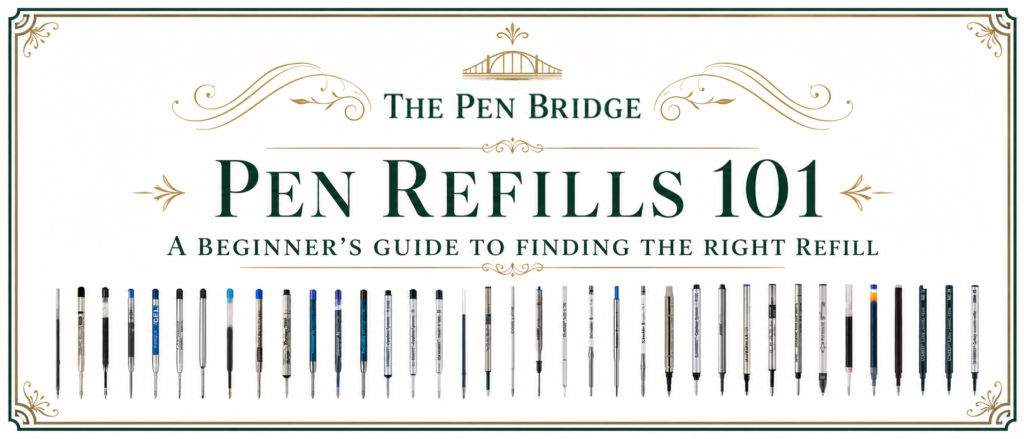
Pen refills are the part of the pen that actually writes, but they are also the part most people think about last. The pen body gives you the weight, grip, clip, style, and feel in your hand, but the refill controls the ink, line width, smoothness, color, drying time, and overall writing experience.
That is why replacing a pen refill can feel surprisingly confusing. Two pens can look almost identical but use completely different refills. Two refills can be the same length but still not fit the same pen. And some refill names, like “G2,” can mean very different things depending on the brand or refill format.
This beginner’s guide explains the most common pen refill types, why they exist, how ballpoint, gel, rollerball, and fountain pen ink systems differ, and how to start identifying the refill you need.
If you already have your refill in hand, start with the Pen Refill Finder to compare common refill sizes and replacement options.
Quick Answer: How Do You Find the Right Pen Refill?
To find the right pen refill, start by identifying the refill itself, not just the pen brand. Remove the old refill if possible, measure its length, compare the tip and body shape, check the ink type, and look for any printed model number or brand code.
The most important things to compare are:
- Refill length
- Refill diameter
- Tip shape
- Shoulder or spring-stop position
- Rear plug or back-end shape
- Ink type
- Pen mechanism
- Brand and refill model number
A refill does not fit just because it is close in length. Pen refill compatibility is mechanical. The refill has to sit correctly inside the pen, extend properly through the tip, retract if needed, and work with the spring or internal mechanism.
The easiest way to understand pen refills is to think of them as both an ink supply and a mechanical part. They have to write well, but they also have to physically fit the pen.
Why Pen Refills Are So Confusing
Pen refills are confusing because there is no single universal refill system. Some refills follow common formats, some follow brand-specific designs, and some are proprietary to one pen family. The easiest way to understand pen refills is to think of them as both an ink supply and a mechanical part. They have to write well, but they also have to physically fit the pen.
For example, a Parker Quinkflow Ballpoint Refill belongs to the broad Parker-style G2 refill family. A Schmidt 635 D1 Ballpoint Refill belongs to the D1 mini refill family. But a Lamy M16 Ballpoint Refill or Parker 5th Refill should be treated as a specific proprietary refill, even if its length is similar to other refills.
The other source of confusion is that refill names are not always intuitive. “G2” can mean a 98 mm Parker-style G2 refill, or it can refer to a 111 mm Pilot G2 gel refill. Those are not the same thing.
For a deeper breakdown of refill naming, see our Pen Refill Codes Explained guide.
The Main Things That Matter When Replacing a Pen Refill
When replacing a pen refills, length is important, but it is only the starting point.

Length
Measure the refill from the writing tip to the very back end. This gives you the first clue. Common refill lengths include about 67 mm for D1 mini refills, 98 mm for Parker-style G2 refills, and around 111 mm for many retractable gel and rollerball-style refills.
Tip Shape
The tip has to fit through the nose cone of the pen. Even a small difference in tip profile can prevent a refill from seating correctly.
Shoulder and Spring Stop
Retractable pens often rely on a shoulder, collar, or spring stop to position the refill. If that point is in the wrong place, the refill may rattle, fail to retract, or stick out too far.
Rear Plug
Some refills have a plastic plug or stepped rear section. That back end can be just as important as the writing tip because it interacts with the click or twist mechanism.
Ink Type
The refill’s ink type affects how the pen writes. Ballpoint, gel, rollerball, and fountain pen systems all feel different because they move different kinds of ink to the paper.
The Most Common Types of Pen Refills
Most everyday pen refills fall into a few broad categories:
- Ballpoint refills
- Gel refills
- Rollerball refills
- Fountain pen cartridges and converters
- Mini refills, including D1
- Parker-style G2 refills
- Proprietary refills
These categories often overlap. A Parker-style G2 refill can be ballpoint, gel, hybrid ballpoint, or pressurized. A 111 mm refill could be a retractable gel refill, rollerball refill, fineliner refill, or proprietary refill. That is why both ink type and physical shape matter.
Ballpoint Refills: Durable, Oil-Based, and Practical
Ballpoint refills are the workhorses of the pen world. They usually use thicker, oil-based ink that is rolled onto the paper by a small ball at the tip.

Ballpoint refills exist because they are practical. The ink tends to dry quickly, last a long time, and work well for everyday writing. Ballpoints are often better for forms, quick notes, cheap paper, pocket carry, and situations where smearing would be a problem.
The tradeoff is feel. Traditional ballpoint ink is thicker than gel or rollerball ink, so some ballpoints require more writing pressure and may feel less fluid.
Common ballpoint refill examples include:
- Parker Quinkflow Ballpoint Refill
- Schmidt P900 Ballpoint Refill
- Lamy M16 Ballpoint Refill
- Fisher Space Pen PR Series Pressurized Refill
- Schneider Express 735 Ballpoint Refill
A useful way to think about ballpoint refills: they are not always the smoothest option, but they are often the most dependable.
Hybrid Ballpoint Refills: A Smoother Ballpoint Feel
Hybrid ballpoint refills are designed to feel smoother than traditional ballpoints while still keeping many of the practical advantages of ballpoint ink. These refills often use lower-viscosity ink that flows more easily than classic oil-based ballpoint ink.

That makes hybrid ballpoints a popular upgrade for people who want smoother writing without fully switching to gel or rollerball.
Common examples include:
Hybrid refills are a good reminder that ink categories are not always perfectly separate. Some refills exist specifically to blend the strengths of different ink types.
Gel Refills: Smooth, Bold, and Colorful
Gel refills usually use water-based gel ink, often with pigment suspended in the gel. That helps gel pens produce darker, bolder, and more colorful lines than many traditional ballpoints.

Gel refills exist because many writers want a smoother, more vivid writing experience. A good gel refill can make a pen feel easier to use, especially for longer writing sessions.
The tradeoff is that gel ink may run out faster than ballpoint ink and can be more prone to smearing, depending on the paper, ink formula, and drying time.
Common gel refill examples include:
- Pilot G2 Gel Refill
- Pentel EnerGel Refill
- TUL Gel Refill
- Uniball 207 Gel Refill
- Parker Gel Refill
- Schneider Gelion 39 Gel Refill
Gel refills are especially popular in retractable office pens, note-taking pens, journaling pens, and refillable pens where smoothness and line darkness matter more than maximum refill life.
Rollerball Refills: Wet, Fluid, and Fountain-Pen-Like
Rollerball refills usually use water-based liquid ink. Like ballpoint and gel pens, rollerballs use a small ball at the tip, but the ink is thinner and flows more freely.

Rollerball refills exist because they offer a wetter, more fluid writing feel. A good rollerball can feel closer to a fountain pen than a traditional ballpoint. The line is often darker, smoother, and easier to lay down with light pressure.
The tradeoff is that rollerball ink can be more paper-sensitive. On some paper, it may bleed, feather, or take longer to dry.
Common rollerball refill examples include:
- Schmidt 888 Rollerball Refill
- Schmidt 5888 Rollerball Refill
- Schmidt P8126 Rollerball Refill
- Waterman Rollerball Refill
- Parker Rollerball Refill
- Lamy M63 Rollerball Refill
- Lamy M66 Rollerball Refill
A simple rule of thumb: ballpoints are practical, gel refills are bold and smooth, and rollerballs are fluid and wet.
Fountain Pen Cartridges and Converters: A Different Kind of Refill
Fountain pens are different because the “refill” usually does not include the writing tip. In a ballpoint, gel, or rollerball pen, the refill typically includes both the ink supply and the writing tip. In a fountain pen, the nib and feed usually stay with the pen, while the ink supply is replaced or refilled.
Most beginner-friendly fountain pens use one of two systems: Ink Cartridges and/or Ink Converters.


A fountain pen cartridge is a small pre-filled ink container. When it is empty, you remove it and install a new one. A converter is a reusable reservoir that fits where a cartridge would go, allowing the pen to be filled from bottled ink.
Fountain pen ink is typically water-based and flows from the reservoir through the feed to the nib. This is part of what gives fountain pens their smooth, expressive feel, but it also means paper quality, ink choice, drying time, and cleaning can matter more.
The Lamy T10 Ink Cartridge is one example of a brand-specific fountain pen cartridge. Some fountain pens use common cartridge types, while others use proprietary cartridges or converters.
Fountain pens open up a different kind of refill world. Instead of only asking “which refill fits this pen,” fountain pen users also think about ink color, nib size, flow, shading, paper performance, and cleaning.
Mini Refills and D1 Refills
D1 refills are small mini refills, usually about 67 mm long, used in many multi pens, compact pens, and small twist pens.

They are useful because they allow very small pens or multi-function pens to hold one or more writing refills in a tight space. The tradeoff is ink capacity. A D1 refill is much smaller than a full-size ballpoint or gel refill, so it usually will not last as long.
Common D1 refill examples include:
- Schneider Express 56 D1 Ballpoint Refill
- Ohto R-4C5NP / R-4C7NP D1 Refill
- Schmidt MegaLine 620 D1 Ballpoint Refill
- Schmidt easyFLOW 6000 D1 Refill
- Schmidt 635 D1 Ballpoint Refill
For a deeper breakdown, see our D1 Mini Refill Guide.
Parker-Style G2 Refills
Parker-style G2 refills are one of the most common refill formats for nicer ballpoint pens, twist pens, and many refillable everyday pens. They are usually about 98 mm long and are available in ballpoint, gel, hybrid ballpoint, and pressurized versions.

This format is popular because it gives pen makers and users a lot of flexibility. A pen that accepts Parker-style G2 refills may be able to use a classic ballpoint refill, a smoother hybrid refill, a bolder gel refill, or a pressurized refill designed for rougher conditions.
Common Parker-style G2 refill examples include:
- Parker Quinkflow Ballpoint Refill
- Parker Gel Refill
- Schmidt easyFLOW 9000
- Schmidt P900 Ballpoint Refill
- Schmidt MegaLine P950 Pressurized Ballpoint Refill
- Schneider Gelion 39 Gel Refill
- Monteverde Parker Style Ballpoint/Gel Refill
For more detail, see our Parker Style G2 Refill Guide.
Because Parker-style G2 is both a refill format and a pen-body ecosystem, we also put together a guide to the best pens that take Parker-style G2 refills.
Pilot G2-Style and 111 mm Gel Refills
Pilot G2-style gel refills are usually around 111 mm long and are common in retractable gel pens. This is different from Parker-style G2, even though both use the name “G2.”
This is one of the most common refill-name traps. A Parker-style G2 refill is usually a 98 mm format. A Pilot G2 gel refill is part of a longer retractable gel refill family.
Common 111 mm gel refill examples include:
- Pilot G2 Gel Refill
- Pentel EnerGel Refill
- TUL Gel Refill
- Uniball 207 Gel Refill
- Pilot FriXion Gel Refill
- Zebra LV-Refill Gel
- Zebra NC-Refill Gel
For more detail on this size range, see our 111 mm refill guide.
Proprietary Refills
Proprietary refills are designed for a specific brand, pen family, or refill system. These are often the safest refills to match by exact model number rather than by length alone.
Examples include:
- Lamy M16 Ballpoint Refill
- Lamy M22 Ballpoint Refill
- Lamy M63 Rollerball Refill
- Lamy M66 Rollerball Refill
- Parker 5th Refill
- Caran d’Ache Goliath Ballpoint Refill
- Sheaffer K Style Ballpoint Refill
- Montblanc Ballpoint Refill
Proprietary does not always mean bad. In many cases, proprietary refills are designed to match the pen body very well. The downside is that replacement options may be limited.
How to Identify the Refill You Need
If you are not sure what refill your pen takes, follow this process:
- Remove the old refill if possible.
- Look for printed text, model numbers, or brand markings.
- Measure the refill from tip to back end.
- Compare the refill’s tip shape and shoulder.
- Check whether it is ballpoint, gel, rollerball, fineliner, or fountain pen.
- Look at the rear plug or back-end shape.
- Compare it with known refill families.
- Confirm the exact refill before buying.
A refill can be close and still be wrong. If the refill is too short, it may not extend. If it is too long, the pen may not close. If the shoulder is wrong, the spring may not work. If the tip is wrong, it may not fit through the nose cone.
Start with the Pen Refill Finder if you want to compare common refill sizes visually.
Common Refill Mistakes to Avoid
Mistake 1: Assuming the pen brand is enough
Knowing the pen brand helps, but it may not be enough. A brand like Parker, Lamy, Cross, or Montblanc may use several different refill systems.
Mistake 2: Confusing Parker-style G2 with Pilot G2
Parker-style G2 and Pilot G2 are not the same. One is usually a 98 mm refill format. The other is a longer gel refill family.
Mistake 3: Matching by length only
Length helps narrow the search, but it does not prove compatibility.
Mistake 4: Ignoring the refill tip
The tip has to fit the pen opening correctly. This matters especially with rollerball, gel, and proprietary refills.
Mistake 5: Forgetting about the spring or mechanism
Retractable pens depend on the spring, shoulder, and rear section of the refill. A refill may fit inside the barrel but still fail to click or retract properly.
The Pen Body Is Optional. The Refill Is Not.
A pen body can be beautiful, heavy, balanced, sentimental, or expensive. But the refill is what touches the paper.
That is why the same pen can feel completely different with a different refill. A scratchy refill can make a great pen disappointing. A smooth refill can make an inexpensive pen surprisingly enjoyable. Once you understand refill compatibility, you can often improve a pen without replacing the pen itself.
This is the main idea behind The Pen Bridge: pen refills are not just a replacement part. It is the writing system inside the pen.
Where to Go Next
If you are new to pen refills, start here:
- Use the Pen Refill Finder if you are trying to identify a refill by size or shape.
- Read the Pen Refill Codes Explained guide if you are confused by terms like G2, D1, C1, X20, and A2.
- Read the Parker Style G2 Refill Guide if your refill is about 98 mm long and looks like a Parker-style refill.
- Read the D1 Mini Refill Guide if your refill is about 67 mm long.
- Read the 111 mm Refill Guide if you are comparing Pilot G2, Pentel EnerGel, TUL, Uniball, Zebra, or similar long gel refills.
You can also browse our brand guides if you know the pen brand:
- Parker Pens Guide
- Pilot Pens Guide
- Pentel Pens Guide
- Lamy Pens Guide
- Schmidt Pen Refills Guide
- Schneider Pens Guide
- Cross Pens Guide
- Fisher Space Pen Guide
- Zebra Pens Guide
- Uniball Pens Guide
- Waterman Pens Guide
FAQs
What is the most common pen refill type?
Ballpoint refills are probably the most common everyday refill type because they are practical, long-lasting, and widely used. Parker-style G2 refills, D1 mini refills, and 111 mm gel refills are also very common refill families.
What is the difference between ballpoint, gel, and rollerball refills?
Ballpoint refills usually use thicker oil-based ink. Gel refills usually use water-based gel ink. Rollerball refills usually use water-based liquid ink. Ballpoints tend to be practical and quick-drying, gel refills tend to be smooth and bold, and rollerballs tend to feel wet and fluid.
Are all G2 refills the same?
No. Parker-style G2 refills and Pilot G2 refills are different. Parker-style G2 usually refers to a 98 mm refill format, while Pilot G2 refers to a longer retractable gel refill family.
How do I know if my refill is ballpoint, gel, or rollerball?
Start by looking at the ink behavior. Ballpoint ink is usually more controlled and may require more pressure. Gel ink is usually darker, smoother, and more colorful. Rollerball ink is usually wetter and more fluid. If the refill has printed markings, use those first.
Are fountain pen cartridges considered refills?
Yes, but they are different from ballpoint, gel, and rollerball refills. A fountain pen cartridge replaces the ink supply, while the nib and feed usually stay with the pen.
What is a converter in a fountain pen?
A converter is a reusable ink reservoir that lets many cartridge-style fountain pens use bottled ink instead of disposable cartridges.
Can I replace a ballpoint refill with a gel refill?
Sometimes, but only if the gel refill is made in the same compatible format. For example, some Parker-style G2 pens can accept Parker-style gel pen refills. But you cannot assume that any gel refill will fit just because the length is close.
Why does my refill fit inside the pen but not work?
The refill may be the wrong shape even if it fits inside the barrel. The tip, shoulder, spring stop, or rear plug may not line up correctly with the pen mechanism.
Final Takeaway
Pen refills are confusing at first because they combine ink type, physical size, brand naming, and mechanical compatibility. Once you understand the basics, the process gets much easier.
Start by identifying the refill itself. Measure it, compare the shape, check the ink type, and match the refill family. The pen body matters, but the refill is what creates the actual writing experience.
Related Refills
- Parker Quinkflow Ballpoint Refill
- Parker Gel Refill
- Pilot G2 Gel Refill
- Pentel EnerGel Refill
- Schmidt easyFLOW 9000
- Schmidt 635 D1 Ballpoint Refill
- Schmidt 888 Rollerball Refill
- Lamy M16 Ballpoint Refill
- Lamy M63 Rollerball Refill
- Lamy T10 Ink Cartridge
Related Guides
- Pen Refill Finder
- Pen Refill Codes Explained
- Parker Style G2 Refill Guide
- D1 Mini Refill Guide
- 111 mm Refill Guide
- Parker Pens Guide
- Pilot Pens Guide
- Lamy Pens Guide
- Schmidt Pen Refills Guide
- Cross Pens Guide